
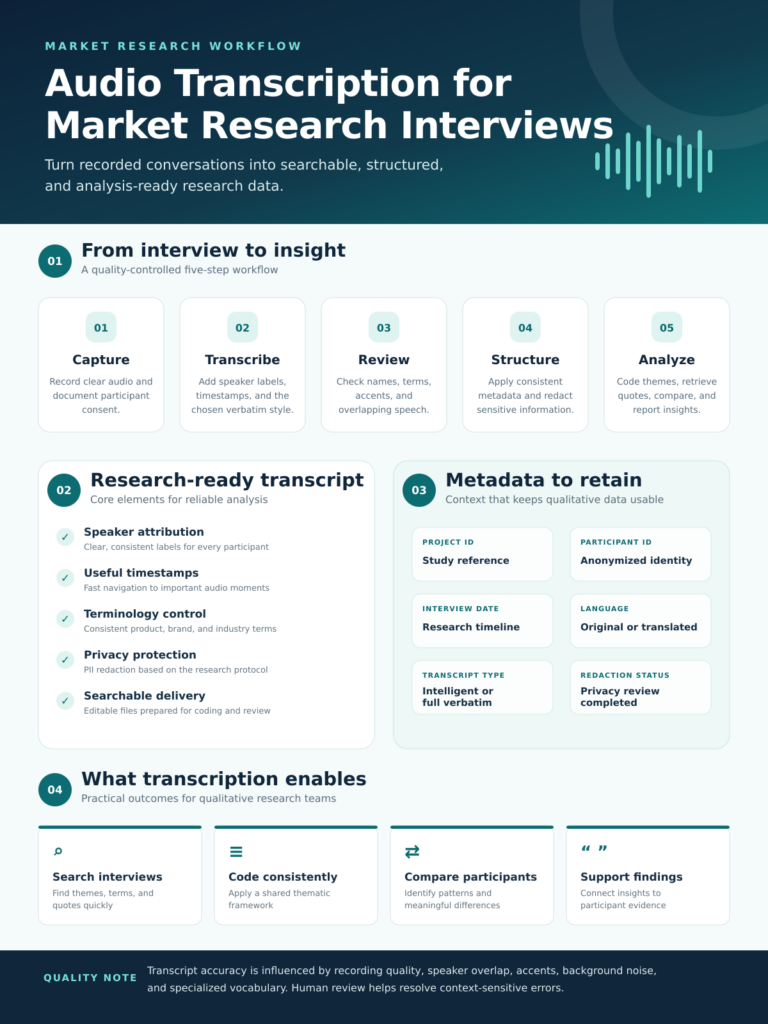
Good market research starts with a conversation first. Be it a client feedback interview, or patient satisfaction study, the focus group for testing out new service – the conversation is only useful if someone follows up and pull-out what matters. This is much more challenging to perform from an audio file than it would be on written transcript, that’s where transcription earns its place in the research process.
Why Audio Alone Falls Short
Audio is hard to search. If you’ve ever needed to locate one specific remark hidden within a 90-minute interview, then you’re familiar with the agony: scrubbing back and forth, guessing at timestamps, listening to the same ten minutes twice.
That is solved simply with a transcript. When your interviews are in writing, you can search across all the conversations at once, extract quotes in seconds, and see when the same issue is cited multiple times by different participants. It’s this repetition where the real insight lives.
This is particularly important for law firms and healthcare organizations conducting research on clients or patients. Instead of having to listen through hours of raw recordings, a partner or physician can quickly review findings using a transcript.
Human Styled Version Verbatim or clean: Which Transcript is Right for You
A transcript does not have to be strictly the same for every project. A verbatim transcript records everything – pauses, false starts, even filler words. This level of detail suits behavioural research or usability testing, where how something was said matters as much as what was said.
A cleaned transcript removes the fillers and cleans the grammar whilst retaining meaning. This is the easier, more readable option of the two in most cases for client interviews or satisfaction studies. Knowing which one you want to order beforehand saves time and costs in the future.
What It Typically Costs
Market research transcription services usually charge about $0.50 to $2.00 per audio minute, and this also depends on turnaround time, audio quality, and the number of speakers. At the top of your list are group discussions with overlapping voices, which takes longer to negotiate and transcribe carefully. It’s a fair trade – little more upfront for a transcript your team can rely on immediately.
Why Accuracy Deserves Extra Care
A transcription error is not merely a trivial mistake especially in legal & medical research. A typo, an incorrect speaker, a garbled figure, can progressively change how one comment is read and by what decision it will have to be made.
And this is why fully automated tools, no matter how fast has real limits. This becomes especially difficult with overlapping speakers, accents, and specialized terminology. For research with the purpose of supporting real decisions, having fast technology together with slower human review can be a game changer.
Protecting Participant Confidentiality
It is common in legal and healthcare research for interviews to involve sensitive information – personal circumstances or health-related details or volunteered opinions that an individual only feels comfortable sharing if assured it will be treated with confidence. A quality transcription service treats this seriously: secure file transport, limited access and data protection should be standard operating procedure as opposed to a special request.
Turning Transcripts into Insight
Once interviews are transcribed, the real analysis can begin. Transcripts are used by teams to thematically cluster responses, extract exemplary participant quotes for reports or presentations and capture the language people use as they talk about their experience. A well-chosen quote usually will convince a stakeholder more than a whole page of summary ever could.
This is not realistically working just with the raw audio. Without the transcript, there is no analysis.
Frequently Asked Questions
“There are many tips for client interviews, but do I need verbatim / clean transcripts? “
A clean transcript (i.e. the meaning is kept intact and its readable by most) serves well to almost all standard client or patient interviews. Verbatim transcripts work best for research on behaviours or usability in detail.
“How accurate does a research transcript have to be? “
A good accuracy for legal and medical research should be very close to 99%. Unless there is a human to test the data after it has been generated, automated tools very rarely hit this level.
“Is the data for my participants confidential? “
An established transcription service should always maintain secure file handling and limited access especially for sensitive interviews in the legal or healthcare domain.
Getting Started
When you are having interviews, focus groups or feedback sessions transcription should not be an afterthought. Seal the deal on whether you need verbatim or clean transcripts as soon as possible, clarify what happens to sensitive data and allow for turnaround time when planning your project.
You gain genuine insight from every interview you record; transcription is just the bridge to use it. If you want accurate, confidential digital transcripts for your next research project our expert legal and medical market researchers’ transcription services can help. “Get a free sample or quote from American Transcription Services”
Our Legal Services
legal transcription New York, legal transcription New York City, legal transcription California, legal transcription Los Angeles, legal transcription San Francisco, legal transcription Texas, legal transcription Houston, legal transcription Dallas, legal transcription Austin