

Ninety minutes of preparation. A chamber of registrants, live questioning, and genuine subject matter expertise on the record. Then the phone call ends – and for most firms and practices, so does the value. An unwatched replay link sits nestled within an unopened email, never opened a second time. The insight was real. The return on it wasn’t.
The solution to your problem is not a new and improved webinar. A more sensible next stage is the transcript – properly reviewed – early in the pipeline instead of late. One document feed into one event that turns into a blog, a report ready for clients, captions everyone can follow along with, and an FAQ page composed of the real questions people asked. This is not a content hack for lawyers and doctors. It’s the difference between expertise displayed once and expertise constantly being discovered.
Begin at the Transcript, Not the Highlight Reel
All the assets below are built from one single source. Get that wrong, and the error propagates through everything downstream – a speaker who spoke at X in a panel discussion but is misidentified by name, a statute number transcribed one digit off and turned from a minor issue into a criminal complaint, or a drug name garbled into something altogether unrecognizable. If it is fixed once, in the transcript, it is fixed everywhere at once.
There are two formats here that matter and choosing the right one will affect everything downstream. Verbatim transcription means recording every word without alteration, including false starts – it is the gold standard for a document that will likely have to be referenced in an argumentative way later. Edited transcription improves fluency while retaining the substance, making it a more appropriate style for conversational content that can be cleaned up and better optimised for repurposing from a single unscripted item, such as a webinar or recorded talk.
Blog: Split the Argument, Not the Summary
The instinct is to condense everything from an entire webinar into a single post. Resist it. A strong session often has two or three disparate and separable arguments – a liability cap, a treatment track, some sort of regulatory change. Treat each with its own article rather than slumping all three into a vague recap.
In practice, where 60 minutes might cover all three areas of employment law change, each can become one tighter post – notice requirements, remote-work classification, and enforcement trends could become separate posts that target different search queries rather than having those same queries competing with one another.
Here, it is necessary to place specific emphasis on the Q&A part. Those questions are literally what your next prospective client or patient may be asking. Pull them right out of the transcript and now they become a truly useful FAQ page – not one you have to guess at.
Report: Structure Over Chronology
With a professional audience, for example, a written report has greater heft than a blog post – something that gets forwarded by referral partners or filed by compliance officers. Creating one from a transcript should be thematic rather than chronological: an issue statement up top, findings or recommendations in the body, and concluding statements at the end. The transcript provides the substance. Editing provides the credibility.
A background, clinical findings, and proposed next steps – not a scene-by-scene roll-up of what was said, by whom, and when. That is the way it should work in practice: a CME panel hashing out a new diagnostic protocol turns into an article.
Here is another example of where a transcription mistake is more than just an annoyance. This can become a question of liability – not formatting – when a statement is arbitrarily attributed to the wrong person, or a clinical guideline or legal standard is stated incorrectly.
Captions: Designed for Both Audiences at Once
Captions help Deaf or hard-of-hearing viewers, as well as the significant number of people who play video muted by default. For many practices, that is a requirement under accessibility standards and not merely a courtesy. Captions also provide searchable text that can help search engines and AI-powered search tools understand video content-they cannot rely on raw audio alone. And if the webinar you publish is uncapped, much of its spoken content is functionally unsearchable.
This is another place where the rule of accuracy holds true: a mistake in a caption is just as visible, and just as harmful to the credibility carried over from the transcript it came from.
Retention and Discoverability – The Truth That Almost No Providers Talk About
This is the part that’s easy to miss – and where legal and medical practices need a different perspective than, for example, a traditional business webinar host.
A transcript of a webinar containing legal analysis or clinical guidance is not merely content. As a record of what was expressed, alleged, or counselled, and depending on your practice area and where you do business, the content may be subject to discovery in litigation or other statutory retention duties. If you plan to repurpose a transcript into public-facing content, there are three questions that should be asked internally: Who can view the transcript? For how long, and under which policy? And before it is made available through public-facing channels, does it require review – by counsel, a compliance officer, or the presenting physician?
This, however, should not lead to a slow response. It should define it: create sign-off as an integral part of your normal workflow so that every future webinar runs through it automatically.
A System, Not a One-Time Project
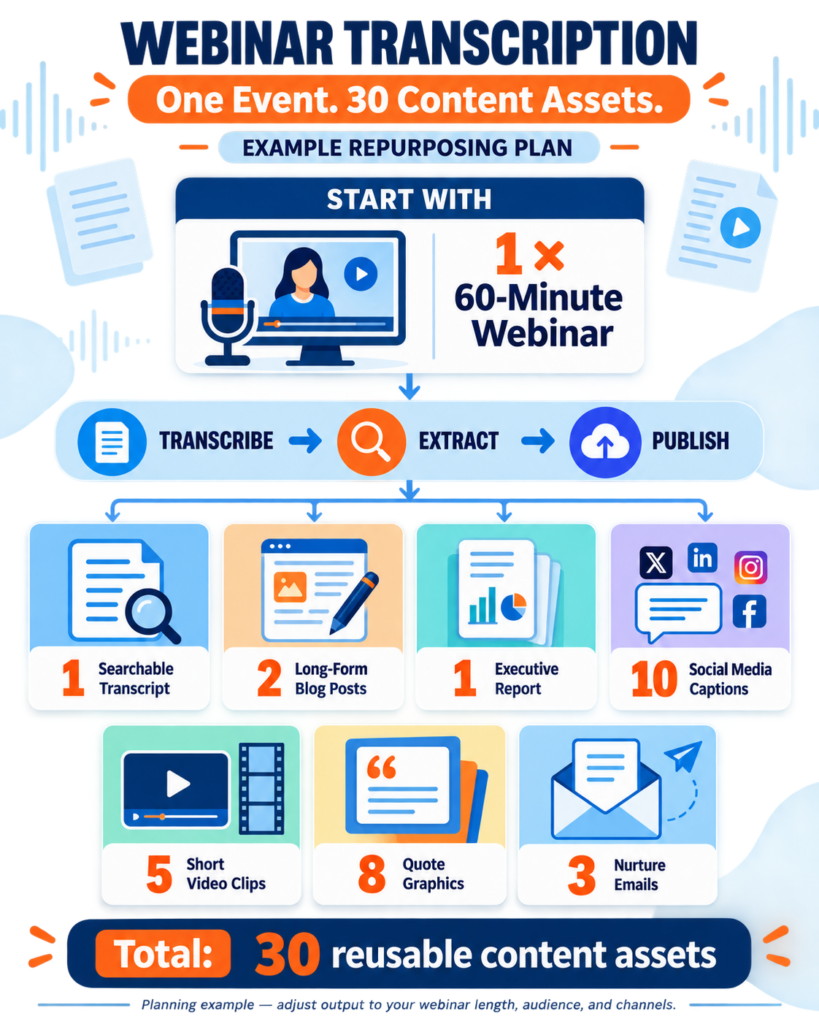
The actual benefit is not simply in transcribing a good webinar. It means creating a repeatable pipeline:
Record → Transcribe professionally → Extract a blog post, a report, and captions → Route the public-facing version through an appropriate review
In that order, again, without re-deciding the process from the ground up each time. With a single hour of live expertise, done this way, you keep appearing in search and bringing in inquiries weeks after the last attendee logged off.
Need precise, human-reviewed transcription designed for legal and medical webinars? -Get an instant quotation for your next event.
Our Legal Services
legal transcription New York, legal transcription New York City, legal transcription California, legal transcription Los Angeles, legal transcription San Francisco, legal transcription Texas, legal transcription Houston, legal transcription Dallas, legal transcription Austin