

A slip here and there is okay some transcripts.ba.dot.bat. A marketing video, notes from the Podcast and Tuesday’s team call. Things are said incorrectly, someone laughs it off– and everyone walks away from you.
Other transcripts can’t. The one being read across a courtroom. Dictating into a patient’s chart The line-by-line earnings call everyone, including analysts and regulators are going to go through. In those cases, the transcript is far from an easy-to-consume summary. It is the official account of what happened. It is be spoken exactly as worded by the people who are acting upon it.
We have been working in that second bucket for a long time. Inside view of Ello.
Legal: the transcript stands as testimony
The transcript is not just the record of what kicks up in a court case and indeed ask any trial lawyer about transcripts and you can see very quickly that each other place exactly will start calling with it. It is the record.
Months later, a deposition is read back to witnesses -preparedly – and word-for-word, asking where did the sentence change. If ‘can’ comes out as ‘can’t,’ testimony just turned. Not knowing, this is high murderin if a name comes out strangled. Even punctuation matters here. A period = silence while a comma = some slight break in the flow.
Add to that legal audio is hard. Lawyers talk, at all times, over one another. Witnesses stammer, backtrack and freeze at the worst possible time. Much of the vocabulary is in Latin. Anyone that transcribes it has to know this world, is aware “voir dire” exists and “your buyer” doesn’t, a sustained isn’t ever swapped with overruled.
However, when the transcript is at its best, that one document from all parties to a case can be trusted. Both sides argue from it. The court relies on it. That is the justice you get out of legal accuracy.
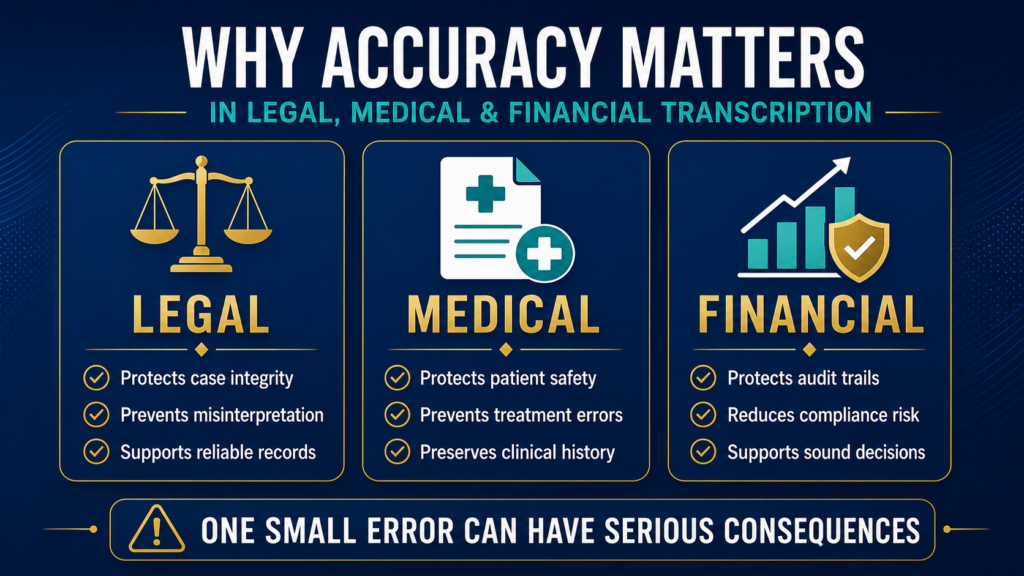
Medical: different treatments, two letters apart
There are a few sets of medical terms that we think about often. Hyperkalemia and hypokalemia. Two letters of difference. Opposite conditions, opposite treatments. And in a phone recording done hallways within the hospital, they sound virtually indistinguishable.
That is a trap endemic to medicine. Fifteen milligrams versus fifty. Hypo-this and hyper-that. Drug names that sound like other drug names. In other words, the person who is typing up the doctor isn’t just a fast typist. They represent the final check between a word in smear and one on an everlasting chart. The good ones know enough medicine to stop and think, hold up – that doesn’t fit this patient.
The chart speaks plainly only when the transcript is right and any doctor who opens it next can trust what it says, without batting an eye. In healthcare, that’s not a small deal. Accuracy is a part of the care itself here.
Financial: the numbers must add up
With financial data, it is the numbers that keep you honest.
On an earnings call, say “fifteen million,” and have it transcribed as “fifty million” – that’s not a typo anymore; it’s misinformation linked to a stock price. These are all documents a regulator may request and the market can respond to: investor calls, audit interviews, compliance recordings. Wording gets studied. “About,” and “exactly are different kinds of promises! Small words, big consequences.
By contrast, a firm with clean transcripts has an asset – clear quotes of who said what. Compliance is calmer. Here, investor relations could pull quotes without running three checks. Nobody spends a Friday afternoon arguing what the CFO really meant.
What accuracy really takes
There is such a pattern with all three domains. The sound is garbled, the words invented and there can be a great deal of pride intimately for genuine error being appropriately punished with extreme (and fitting) severity. And real accuracy requires three things, none of which is typing speed.
First, knowledge of the field. A word which does not belong in the sentence is noticed. Second, judgment. If a phrase is ambiguous mark it as unclear. An honest [“inaudible”] is the mark of a professional in this line of work. A hidden guess is dangerous. Third, a second review. And before anyone downstream (Bankers?) trusts the transcript at all, it is checked against the raw audio by a third party.
That’s really the whole point. It was never the typing that’s difficult. The tough part is knowing what it is that you’re hearing.
The bottom line
Good enough, you say great transcripts! Copyright: Legal, medical and financial transcripts must be accurate because they do not just sit in a folder. They are quoted in courts, acted upon in hospitals, and filed with regulators. Accuracy is not one quality of a transcript among many when the transcript is an official account. It’s the product.
That is exactly why American Transcription Services was created. For over 26 years we are the industry experts with experience in novice, medical and audio since 1999 – buying you specialists who know their game along a second review on every file completed whilst having all your data covered by proper security. For the last 26 years, no one has been eager to lower the stakes in these industries. Neither has our standard.
Our Legal Services
legal transcription New York, legal transcription New York City, legal transcription California, legal transcription Los Angeles, legal transcription San Francisco, legal transcription Texas, legal transcription Houston, legal transcription Dallas, legal transcription Austin