
Somewhere in your organization today someone is already running an AI transcription app. It could be attending meetings; it might be parsing through client calls. Its fast, practically free and – most of the time – it works fine.
Most of the time. Which is really the entire conversation, right.
Determining if AI transcription works for you is not a question of “how good the software really is at getting it right.” And it all distills down to a much smaller, far more piercing question – what if it’s wrong? Frankly, nothing really happens for a lot of recordings. Nobody notices, nobody cares. However, for some audio – a doctor’s notes or maybe a research interview or perhaps even part of courtroom testimony (you get the picture) being incorrect means an actual medical record that will be tainted forevermore, not to mention possibly damaging what someone actually said as “off-the-record” moment.
But enough is enough already, so let us disentangle which is which.
Give AI its due
Automatic speech recognition really has become a lot better. Feed a contemporary tool a pristine recording – one or two voices, quality mics, no crosstalk etc. – and you can have yourself an actionable transcript in minutes for pennies on the dollar and sometimes even free.
And to be honest, for much of the everyday audio – this is just right. As they note: internal meeting notes no one will ever quote back to you rough drafts of podcast episodes Records of lectures that you are storing for self-study. Brainstorms where close enough is actually good enough. If the transcript is throwaway, then use AI. Actually – to get anything more there is just a waste of money.
Now coming to that accuracy number,
AI transcription tools often advertise anywhere from 85 to 95 percent accuracy. Measuring word error rate in pretty forgiving conditions that conceals more than it reveals.
Lets do the math on the low end for a moment. For example, a hour long recording translates to about 9,000 words. That’s approximately 900 mistakes (at an accuracy of only 90%)). Still at 95 percent you are still carrying 450. And here’s the bit that marketing pages never really talk about: the errors aren’t random. They cluster themselves right on the words that evoke most meaning.
Negations, for one. “Can” and “can’t.” “Did” and “didn’t.” Phonologically they are homophones; semantically they are antonyms. So, where the audio is ambiguous it simply takes a statistical guess at which word was right and keeps going – never once pausing to mention that it took its best shot.
You are next trained on names and jargon. Daubert becomes “Dow burt.” Their names come out sounding like things you would put together to create a meal. Name of companies, case citations, technical jargon – anything that is not frequent in the corpus used for training will be silently replaced by something appearing there.
Numbers trip it up too. Dosages, dollar amounts, dates. But that “15” in a patient’s chart at that point is not just a typo – it’s commodity living full time on the books.
A set of overlapping speakers are a mess in themselves. An argument in a meeting, or the back and forth of a focus group; even an ongoing deposition: people interrupting each other constantly is simply how humans converse – yet AI either fuses all those voices together into one muddled-speaker soup or silently plucks out any overlap.
And then, real-world audio. Speaker phones, accents^1 background noise and someone walking away from the mic mid-sentence. Under those conditions, one can expect to see error rates exceeding 25 percent, and easily.
The worst part is not one of these error types, but rather all of them. Instead, the model does not know when it is failing. It outputs text, confident and grammatical, a perfectly readable sentence whether it heard you correctly or not – mistakes that do not seem like mistakes just laughing out as the assumed right answer in front of everybody.
What are you really paying a human for
It’s not faster typing; really, the truth is in this difference – AI forecasts, humans interpret.
But when a well-trained transcriptionist encounters an incomprehensible phrase, they don’t intuit the word that’s probably most popular. They rewind. They would compare that with what the speaker had said two minutes earlier. Bids are already familiar with the fact that “voir dire” is a legal term and not what it sounds like: vwar deer. As they hear the new voice on the line, at minute forty, they mark it correctly for the remainder of this recording. And if a passage is truly inaudible, they attribute it as (inaudible) rather than creating something that just sounds good.
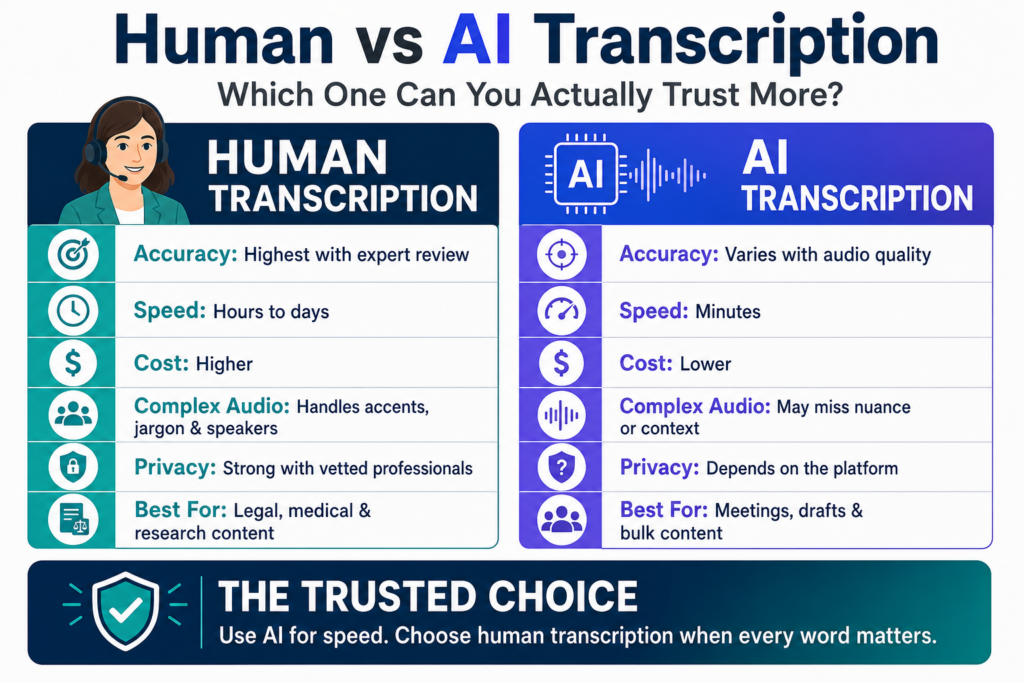
That is why professional human transcription lands at 99 percent or better on the identical messy audio which pulls AI below 90, and that is nonetheless these days a default for something with an involved prison, clinical or monetary burden.
The “cheaper” option, priced honestly
These are the numbers that never seem to appear on an AI tool’s pricing page.
If you auto transcribe an hour of interview audio for $10, and then pass that off to a paralegal/assistant who charges $60/hr to fix up the mess. If a transcript has 90 percent accuracy, fixing it properly takes about 3 to four hours per hour of audio: you have to listen all the way through because mistakes often look like perfectly fine sentences. Now you’re at 190 to 250 plus your staff time for a transcript of what they missed anyway, on late Friday afternoon.
On the invoice Print (with a Human Silence) is more costly and takes place complete. No re-listening. No correction pass. There was nothing to be quietly unsure of what trickled down the cracks somewhere half way between. When it comes to audio that matters, the “expensive” choice is regularly the low cost one when you add everything up.
The one-question decision rule
Don’t bother with the feature comparisons, they don’t really say much at all! Instead, you’re trained to ask – how much does an error cost me?
If the answer is a shrug, AI away, and that actually saves money… so there’s no reason not to.
Whereas if the answer is anything else – compliance foul, mistaken identification, withdrawn statement, exhibit that implodes on cross-examination – you need a human. That includes depositions and court filings, medical records, insurance and compliance documents, data from research interviews you’re quoting in print as a citation; board minutes – and basically anything that someday a regulator might seek to audit.
The bottom line
Transcription has always been easy with AI, but cheap just got you throwaway audio and it is a gift – no argument. However, speed was never really the challenge involved with transcription. And the pattern of being right – reliably, verifiably – on audio that won’t play nice is where it breaks down.
The rest of that was still in the hands of man. That means actual word-for-word, human-generated transcripts typed and proofread by experienced transcriptionists – bonus if you can identify speakers or prove timestamps on demand – that $1 per audio minute has been doing since 1999. If your only future recording is a few words that matter, get the quote American Transcription Services – we guarantee you will be quoted accurately.
Our Legal Services
legal transcription New York, legal transcription New York City, legal transcription California, legal transcription Los Angeles, legal transcription San Francisco, legal transcription Texas, legal transcription Houston, legal transcription Dallas, legal transcription Austin