
“All your best content is stuck in one language”
That keynote your CEO delivered. These are the customer interviews your research team recorded. All of the training videos, all of the podcast episodes and product demos. All of them could be operating for you in ten markets instead of one, and the brands that will win around the world in 2026 know precisely how to make it happen.
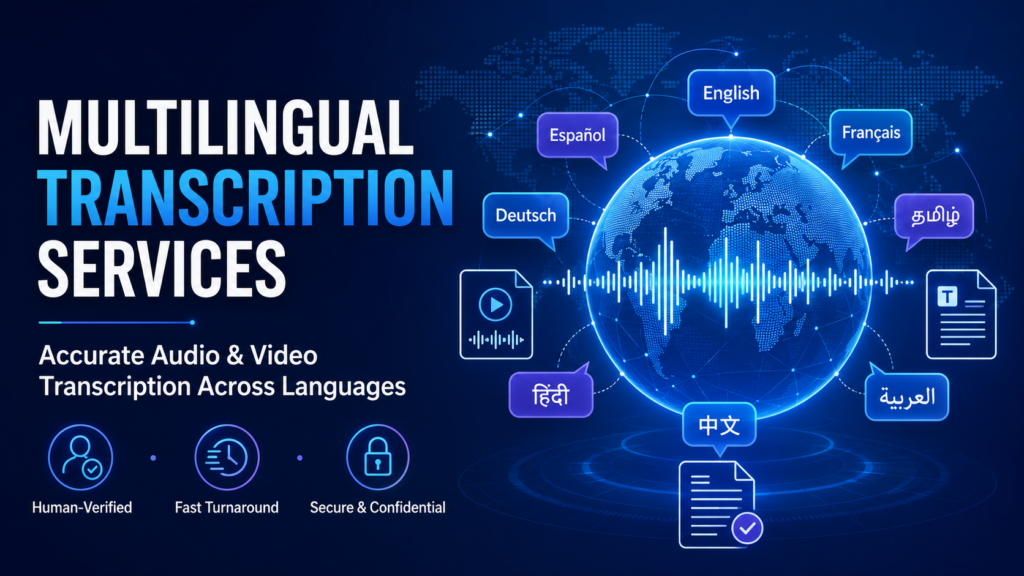
The engine powering it is a little less sexy than your average marketing team might anticipate. While it may sound deceptively simple, world-class localization starts with a perfect transcript before any word is translated, subtitled or dubbed. This is how global brands really make audio work as content that can travel practically everywhere – and what most get wrong.
Step 1: Be perfect with your Source Language
Localization is a chain, and transcription is one of the links in that chain. Each mistake in the source transcript cascades further down: a mis transcribed phrase leads to a poorly translated subtitle, which results in an afflicted customer in another market, speaking another language making your brand look bad.
Serious localization teams always require human transcription on the original content for this reason. Automated tools are still helpful for internal drafts, but they fail on the very subject matter that global brands document most: multi-speaker content, specialized language and regional accents as well as audio recorded in situ rather than a studio. A trained transcriptionist does not only capture the content of what is said, but also its intention, and this serves as a basis for any translator working from.
Global teams have a rule they live and die by localize from an unverifiable transcript. Tighten accuracy at the source, and every downstream language inherits it.
Translation Is Not Localization
This is where most first attempts falter. Translation converts words. Localization converts meaning.
Your CEO’s dry wit might come across as gibberish if translated literally into Tokyo-ese. An idiomatic phrase that resonates with an American readership can be perplexing or even offensive elsewhere. Units, dates, cultural references, formality level: each market has its own expectations and audiences know within seconds if the content was made for them or just converted at them.
The brands that have nailed this use native-speaking linguists from the target culture, not just the language. They change tone, rework references and flag anything that won’t travel. It sounds like something written here, because in every way that matters it was.
Subtitle and Captions: Technical Accessory Meets Cultural
After translating the transcript, it has to work on a screen, and this in itself is like an art. Reading speeds differ by language. Mandarin compresses significantly, and German runs about 30% longer than English. Subtitles have to match the speed of speech; they have character limits and need to be readable on a phone held vertically in some dingy train.
Captioning also does double duty that global brands are realizing they cannot sacrifice accessibility. Correct captions make your content available to deaf and hard-of-hearing audiences in every market, comply with global accessibility laws that are tightening by the year, and unobtrusively increase engagement across-the-board since most social video is viewed without sound.
Multilingual captions are not decoration, they need to be thought out. They represent the singular highest-leverage localization investment for brands.
Consistency Is A System – Not An Ability
One video that works globally is a project. Localizing a content library the same way each and every time is an operation, and operations need systems.
To ensure their product names, taglines and technical terms translate exactly the same every time across any video in any market, global brands keep terminology glossaries. They maintain style guides per language regarding tone and formality. The same trusted transcription and translation team is used throughout projects, allowing the knowledge to build upon itself rather than resetting with each new file.
It is the quietest of contrasts; between brands which feel global, and those that seem to be translated inconsistently. These things may never express it, but they always know.
Security Does Not Stop at the Border
There are so many people who touch your content on multilingual projects – transcriptionist, translator, subtitler, reviewer. The brightest brands multiply their meta work to match.
Before any vendor lays hands on unreleased product audio, internal communications or customer recordings – check the basics: encrypted file transfer, executed NDAs from each linguist and clear responses about where files are processed & stored. One market having a launch video leak can devastate the entire campaign in all of them.
Putting It Together
It is a multi-step process – nail the source transcript with trained humans, place meaning above words in local language by native-speaking linguists, design captions for your relevant screens and reading habits at each market level.
Fix that sequence and one recording becomes 10 assets ready for market. If you got it wrong at step one, then you’re paying for the same sin across every language that you’ve published in.
Human transcription, translation and captioning performed by trained specialists and checked at every delivery level is the work we have built our award-winning reputation on since 1999 here at American Transcription Services. We reliably deliver content in English and other languages where accuracy matters to legal, medical, academic, and corporate teams.
Discover what your audio does in a different language. Provide a sample file, and we will return you with no cost transcript that lets you know exactly where to start.
Our Legal Services
legal transcription New York, legal transcription New York City, legal transcription California, legal transcription Los Angeles, legal transcription San Francisco, legal transcription Texas, legal transcription Houston, legal transcription Dallas, legal transcription Austin