

No matter what a patient says, ALL of these encounter’s end in the same way – someone must translate that speech into the medical record. That record shapes both treatment choices and insurance requests, and legal protection. Make medical transcription one of those services that hardly anybody thought about before it goes wrong, and when the shit hits the fan all at once everybody’s thinking about.
When you look at a transcription vendor in 2026, three things matter: whether the words are correct; whether the data is secure and if they paperwork to support both could stand up to an audit. So, here’s how to score all these three, one after another.
Why the record is the product
It’s not note-taking, Clinical documentation is designed for clinical purposes. It is the foundation of continuity of care, the basis for billing and it will be one of the first documents a malpractice lawyer request. Transcription errors are not cosmetic – a misheard dosage (e.g., “10mg” instead of 100), or dropped discrete elements like “no known allergies,” how lefts and rights in bodily examinations swing between accurate differential diagnosis, flow right into the HER and every downstream decision built on top.
This is the reason that 99% or better accuracy has been adopted as an industry standard for medical transcription. Not as a lazy marketing flourish, but the minimum level of reliable charting.
What 99% actually requires
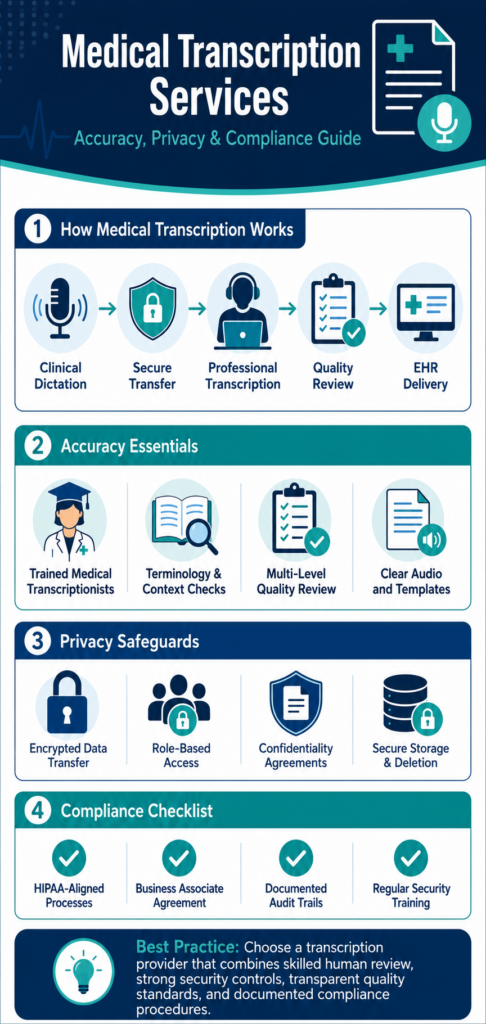
That number, consistently across specialties and audio conditions, really relies on a combination of three things.
First, people who really understand the content. A transcriptionist writing cardiology dictation must be able to hear the difference between hypertension and hypotension at conversational speed, know that Kolodin is not clonidine (these two drugs end up transposed in phi more often than you would think) at 100 words per minute, and determine when a statement just does not add. You can fill software with medical vocabularies. Not in the same way as you load judgment.
Second, layered quality assurance. Then serious providers will not rely on a one-pass through the material. Before anything ever hits the EHR, transcripts are proofread, medication and dosages verified along with patient demographics. If they cannot guide you through their QA workflow step by step when asked to, then it is likely that the QA in question lacks precision as well.
And last but not least, clean audio at the source. A dictation recorded from a phone speaker in the busy corridor is beyond repair, no process can rescue that after it has been done. And 1/2 decent dictation gear (one that can handle noise) is really the cheapest you can get to improve accuracy, without it being on your end of the fence.
Privacy: The component that can ruin careers
This is because anything a transcription service touches, well PHI and when we say that it comes with teeth. Under the 2026 penalty schedule, HIPAA penalties reach $73,011 per violation; egregious violations (by definition only determined by regulatory investigations and findings) of willful neglect are limited to approximately $2.19 million for each category of this violation made in a given year. Small practices are not immune, either – solo providers and small clinics have been slapped with fines as low as $30,000 to more than $250,000 for violations such as missing risk assessments or lack of vendor contracts. Abuse of patient data can also incur criminal penalties, including imprisonment in the most extreme cases.
So when you are vetting the security of a vendor, three questions actually become non-negotiable.
Is everything encrypted, everywhere? Encryption: Audio files and transcripts should always be encrypted both at rest (e.g., stored on the server) and in transit. The phrase, “We use a secure portal” tells you nothing in itself – then ask them which encryption standards does that mean specifically for the safe transit of what data or where it sits.
Who can access the files? This also means fewer people see the work getting done, every access is logged, and provisioning gets revoked on Day 1 of leaving a company. When a vendor cannot precisely articulate their access model, it is better to assume that it means something close to “everyone.
And after the data – what happens to it? This goes for temp files, cached audio, backup copies – everything needs to have a traced and/or auditable deletion process. The residual data laying fallow on a vendor’s server two years after your engagement is finally terminated – well, that’s just an undiscovered defined breach.
Compliance paperwork that needs to be in place before day one
Always first, your Business Associate Agreement. It is a legal requirement that your practice has an executed BAA with the transcription vendor before any PHI crosses between them, and missing BAAs are one of the most frequently cited violations in enforcement actions under HIPAA. If a vendor balks on the BAA, well, that is basically the end of discussion.
Training can also not be a tick box exercise, it has to continue. Any person who has access to your files, and office staff of the vendor if they use offshore staff also need up-to-date HIPAA training & security awareness. Training is really the only defense against phishing, which continues to be how most patient data gets out the door.
And demand proof from independent sources, not just take for granted what they say. Anyone can claim compliance. What separates a compliance program from something like butt normalcy in your website is the third-party SOC 2 report and ongoing penetration testing.
Human, AI, or both?
Transcription has become truly capable at ordinary meetings – speedy issuance, cheapness and mid-90s accuracy on fresh standard audio. If you are a high-volume practice dictating simple progress notes, it is hard to argue with that math.
It is apparently in those instances that the stakes are high: complex words, quickly spoken or heavily accented speech, recordings of more than one speaker and writing down a phrase somewhere with medical judgment requiring you to know right away whether it makes sense. For this reason, many practices find themselves in a hybrid model AI for the first pass, trained human review before anything is committed to the chart. Human-verified transcription is the gold standard for high-acuity documentation, and with good reason. (For more details on how we break down the accuracy trade-offs, check out our guide to AI vs. human transcription.)
The one-step vendor test
Always ask for samples of transcripts in your area, created from audio similar to yours before signing on with anybody. The 99% accuracy – everyone says that on their website | that’s the easy part, right? Hardly anyone is truly volunteering proof on your form of dictation. Those who are not, for the most part anyway.
Your documentation is your permanent record of the care that you give. Pick the people creating it accordingly.
American Transcription Services have been providing human-verified, HIPAA-compliant medical transcription since the year 1999. Fancy seeing how we do it for your specialism? Give us a few sample transcripts and we’ll show you.
Our Legal Services
legal transcription New York, legal transcription New York City, legal transcription California, legal transcription Los Angeles, legal transcription San Francisco, legal transcription Texas, legal transcription Houston, legal transcription Dallas, legal transcription Austin