
Ten years from now, in 2026 if you had to watch a zoom call or live broadcast on television or visit a contact center dashboard for aged chats / voice transcriptions it will be the same thing happening over and again: words appearing like how fast humans can speak. Your brain has learned to accept fantasy becoming routine in the five years since we all got real-time transcription out-of-the-box – which, honestly? Sensibility still struggles with that. It’s genuinely useful. It’s also genuinely limited. And therein lies the gap where most companies get burned.
So here, let’s take a cold hard glance at where live transcription shines, and where it quietly crumbles under the pressure of its own specific weaknesses – or (more helpfully) how to discover what kind of circumstance you’re in before you have something on the line.
How it actually works – Real-time transcription
Unlike conventional transcription, which only kicks in once a recording is finished, real-time or “streaming” transcription can start immediately. The software then takes the audio in subdivisions of brief, overlapping snippets – on average from 50-200 milliseconds – and routes each snippet through acoustic and linguistic models as soon as it stops flowing. Hence the occasional flickering of the text and its various corrections as it progresses through a sentence – that’s literally just the model reconsidering which choice to make in light of further context.
And that detail is bigger than it sounds. The system – as it turns out, at least in a limited way! Remember that, because it helps explain nearly every weakness we’re going to discuss.
Where it earns its keep
Accessibility comes first, always. Live captions enable deaf and hard-of-hearing attendees to understandably follow a meeting, an address, or other kind of broadcast as it unfolds – not 60 minutes later when someone has tidied up the transcript. Live captioning, for public-facing events and educational institutions, is not a nice to have – it is an accessibility compliance issue due to ADA and Section 508 obligations.
And finally, there is the meeting-with-disabled-cleaner-uppers issue that anyone who has ever tried to take minutes-as well as think-will recognize immediately. Nobody contributes well while typing. Live transcription enables everyone to fully participate, and the searchable transcript is literally waiting for you right when the call ends. For remote teams who are dialling in calls one after another, that by itself often pays back the tool.
Contact centers are likely the most advanced use case going right now, and it’s important to slow down long enough to take a peek under the hood. Live transcripts will feed agent-assist systems that surface knowledge-base articles in the moment, flag compliance risks as they happen and run sentiment analysis so a supervisor can interrupt before an angry customer hangs up on somebody. And some will literally steal your credit card number as it is spoken, allowing agents to comply with PCI-DSS processing guidelines without even being aware of the fact.
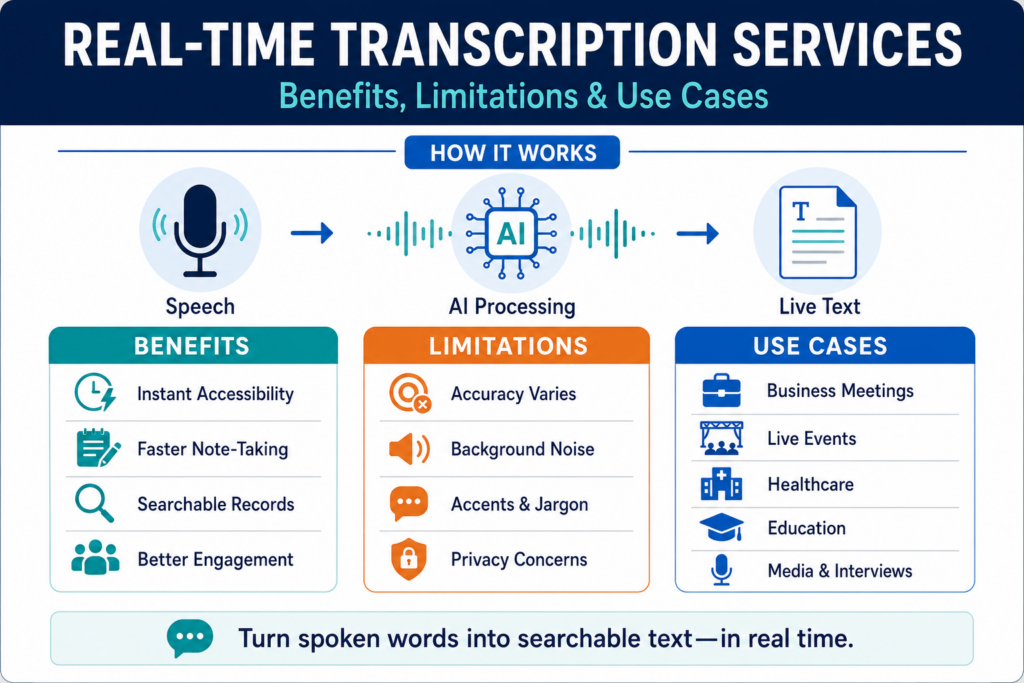
The healthcare dictation is also worth a mention and it represents one of the quieter wins here. It’s a true quality-of-life change to have the physician be able to dictate straight into EHR while still maintaining eye contact with their patient instead of typing notes at nine o’clock right after putting kids in bed. Live speech-to-text eats a somewhat measurable portion of documentation burnout – that is totally real.
And live broadcast and events – sports, news, town halls, earnings calls – where the caption must literally be present at that moment or it is pointless. There, it is all real-time or bust.
Where it breaks – Real-time transcription
Now for the part that vendors usually hide away in some fine print.
Audio quality is king, and I mean everything. They were all trained on data that was predominately clean, single-speaker audio – someone speaking clearly into a good mic in anechoic chamber. And perhaps most importantly, Feed one has conference room portfolio with an HVAC hum going on three people talking over the top of each other and someone dialed in from their car speaker phone alongside a voice detection goes off a cliff. The data supports this: analyses of industries show a reduced accuracy range three to five orders from benchmark conditions in production [1, 2]. Single-speaker medical dictation on controlled conditions is about 9%-word error rate; multi-speaker clinical dialogue can be over +50%. Another classroom study that examined live group recordings with ASR (Automatic Speech Recognition) systems found they failed to capture as much as 8 in every 10 words. Well, the demo always sounds AMAZING and I would argue that there’s a simple reason for this: The demo is ONE person standing there talking into an actual good microphone. Unfortunately, that is not how real life plays out.
These systems are also tripped up by an accent, speed and jargon. “Standard” American broadcast English is pretty well handled / ASR models. Instead, parishioners far better manage a rapid-fire cardiologist saying paroxysmal supraventricular tachycardia – or a shrieking Louisiana attorney spitting out case law. Custom vocabularies partially address this; preload it with drug names, party names, domain-specific technical jargon. That, however, is a band-aid at best.
There’s also just… no lookahead. Take a moment to sit with that phrase. The model is transcribing as the sentence unfolds, so it cannot wait to find out if you meant their there or they’re – let alone whether “the council” was really “the counsel.” The neural model underlying AI transcription by post-processing a recording consistently achieves superior accuracy to real-time output as the entire recording is subject to review. That beats them both – human transcription. (If you want the accuracy math explained in detail, our human vs. AI transcription breakdown covers this more thoroughly.)
Privacy is another one which never gets enough attention. Live transcription is almost a guarantee of cloud processing, which in turn entails you streaming your audio (patient histories/deal terms/PII – whatever’s being said) across the wire as it happens. Just because a vendor has the word “secure” on their homepage, does not mean they are compliant with HIPAA and GDPR – that is completely dependent on the architecture itself + agreements. Automatic PII redaction works, yes, but realistically do not insert anything sensitive into a live service without asking the hard questions first.
Then there is what I would call the distraction tax – highly underrated, and easily missed. Over time people mentally switch to watching captions instead of a conversation. If half the room is silently proofreading a live transcript in their head, that tool is subtracting attention from the room rather than adding to it.
The rule of thumb
Real-time transcription processor is optimized for speed, not precision. Not so much a flaw as the entire design tradeoff, grown in from day one. The real question is what more does your use case need.
If the transcript is a convenience: minutes, an imperfect account of events, live captions where readers simply have to put up with some random gibberish here and there – then real-time AI is quick enough, inexpensive enough and truly good-enough for this use case.
No, if the transcript is a record – a deposition, an independent medical examination (IME), a board meeting – anything that could be quoted or filed or subpoenaed – “good enough” just isn’t good enough anymore; almost overnight. A misheard drug dosage or a “not” dropped in sworn testimony is not just a typo. Deep down, it is a liability – with serious consequences in some cases. Which is precisely why courts, law firms and healthcare providers continue to rely on certified human transcription for anything with any real ramifications attached.
The bottom line
Real-time transcription is good for exactly what it was designed to be used – accessibility, live captions during meetings and in the moment support by providing an agent with conversation transcriptions. Just don’t mistake the live read for the final record. If the words on the page must be correct, verifiably and defensibly right, then what’s held that workflow in place since long before AIs came into being still applies: record it; have a trained human transcribe & verify.
There is a time for speed and there is also a time of accuracy. Knowing which one your situation really requires – this is the whole game.
American Transcription Services has been providing human-verified transcription for legal, medical and corporate clients since 1999. A transcript that you can proudly stand by? Get in touch.