

A dictated consultation note is affordable to have transcribed overseas than by the local medical assistant or secretary. Not a single person asks where the server is located, who has access to it, or what happens to the recording after they receive their transcript. That question becomes a breach notification six months later, when the breach is discovered.
Selecting a medical transcription vendor is not just another administrative decision for healthcare providers – it is a HIPAA compliance decision, with financial and reputational risks that fall on the practice, not the vendor. Few explain what must be true before a patient recording can leave your building.
What HIPAA Really Wants You to Expect from a Transcription Vendor
HIPAA’s Privacy, Security, and Breach Notification Rules cover any type of Protected Health Information (PHI) – such as a patient’s name, birthdate, medical record number, or clinical information – the instant that information is created, transmitted, received, or stored by the practice itself or by a vendor acting on its behalf. That vendor is considered a Business Associate, and before you can send them any recordings at all, that relationship must be governed by a signed Business Associate Agreement (BAA). Encryption and good intentions are not enough to bridge the compliance gap without one – there is no legal protection in place until the agreement exists.
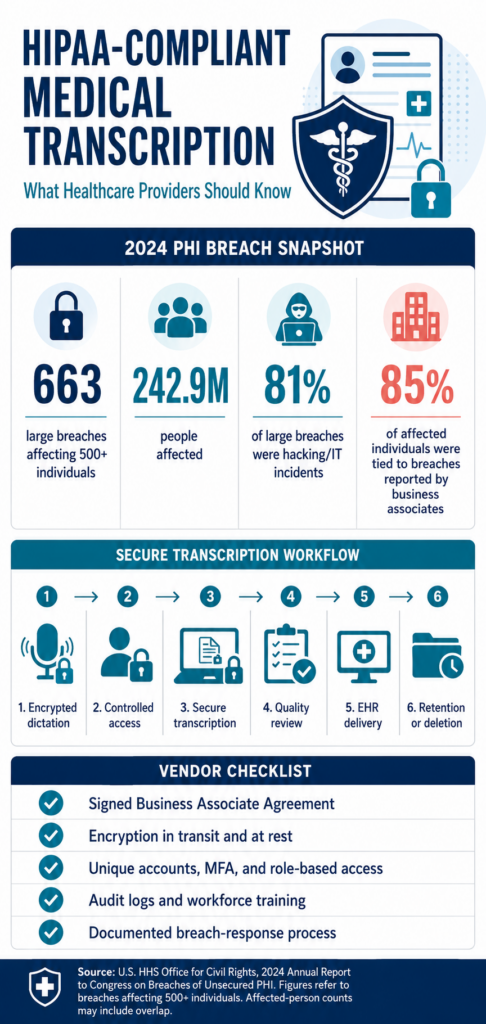
An actual, true HIPAA-compliant transcription workflow on top of that BAA includes:
Not just while it flows between systems, but encryption in transit and at rest so a recording is protected from the time it gets uploaded to when it reaches its destination.
Audit trails – logging of who accessed a file and when, not just a nice-to-have but the basis for compliance in the event regulators come knocking years later.
Staff screened and trained one-at-a-time, with confidentiality obligations that run outside of the platform technical protections.
A breach notification process that is written down and documented, because with HITECH, the standard has been raised about how timely and transparently a breach notice must be transmitted when one occurs.
Why The Offshore Question Is a Much Bigger Problem Than It Looks Like
One of the biggest blind spots in vendor selection is geography. A lot of this is all down to the fact that transcription work is regularly dispatched overseas for money-saving purposes, in addition a requesting practice might never know about precisely what befalls the recording once it leaves its premises, nor which security standard supervises it while it lives on one more server. That is not in and of itself a compliance failure – but it does require the practice, which ultimately controls the patients’ data, to definitively know where its files are being processed.
This principle applies to UK practices who are used to working within NHS data-handling expectations and under the guidance of both the UK GDPR legislation on acceptable encryption standards for clinical correspondence as well as soon, the NHS’ own guidance on this issue. The practice would also be the data controller, therefore obliged to ensure and any vendor is compliant with these – unless proven otherwise, it must be assumed that a vendor is non-compliant.
Human Review: Safety, Not Just Quality
Because a mistyped dose, or mangled medication name, or misheard clinical instruction shows up in the patient’s record, it is not only a compliance issue – it is also an issue of patient safety. And this is why the best medical transcription service providers utilize a hybrid process that combines human review with automated, AI-driven speech recognition instead of complete automation. The hybrid approach routinely captures items that automated transcription misses, especially in dense specialty areas such as radiology, pathology, and orthopaedics where a single misheard word can change the entire meaning of the note.
That has direct harmonized with flow, too. The best transcription services have an integrated service that feeds straight into your EHR or EPR – such as Epic, Cerner (or their NHS equivalent) rather than returning a document that has to be manually re-entered, which is exactly where the copy-paste risk is at its greatest.
Checklist Before You Sign Do
Whenever sharing patient recordings with any transcription vendor, you should always get the following in writing:
- Is a BAA signed prior to the any PHI being sent?
- Is the data encrypted when being transferred or stored (during transit and at rest) with not outdated encryption protocols?
- What is the location of data processing and storage, and does that location meet your regulatory requirements?
- Is there individual vetting of transcribers that are also bound by confidentiality agreements? (Not just the security of the platform technically)
- Is the vendor able to create audit logs upon request – including who accessed a file and when?
How soon is a breach required to be reported?
Is it a workflow that pipes directly into your EHR/EPR or one in which physicians need to manually re-enter that then introduces more error?
Does the output automatically go through human review or is it fully automated?
A vendor that inserts documentation addressing all this, rather than just assurances, shows how seriously it takes its compliance obligations.
The Bottom Line
Essentially, medical transcription straddles the line between accuracy of clinical meaning and regulatory risk. If the practice was going to crank out notes for future review without simultaneously running both risks – encryption alone isn’t good enough, and accuracy alone is not good enough either. Only providers who write, not just “say” a signed BAA, observable security standards, human-verified accuracy and a clear response on where specifically your patients’ data goes should be the ones you trust with their recordings.
Your current vendor must be able to respond without even a moment’s pause to the checklist above – if they cannot, that’s the compliance gap you will want to resolve first.
Does your practice need custom HIPAA-compliant medical transcription? “Speak with our team to see how we can provide dependable clinical”