When you need a recording transcribed, it can be tempting to rely on the fastest option available. Automated tools may seem convenient, especially when you only need a rough draft. But when the transcript needs to be accurate, secure, properly formatted, and ready for professional use, human transcriptionist services still make a major difference.
A transcript is not just a block of text. It may become part of a legal file, medical record, research project, business archive, training resource, interview report, or client-facing document. That means every word, speaker label, timestamp, pause, correction, and formatting choice can matter.
At American Transcription Services, we provide human-led transcription services for professionals who need dependable results. Our services include legal transcription, medical transcription, interview transcription, text translation, and audio translation, with trained human professionals preparing accurate, review-ready transcripts.
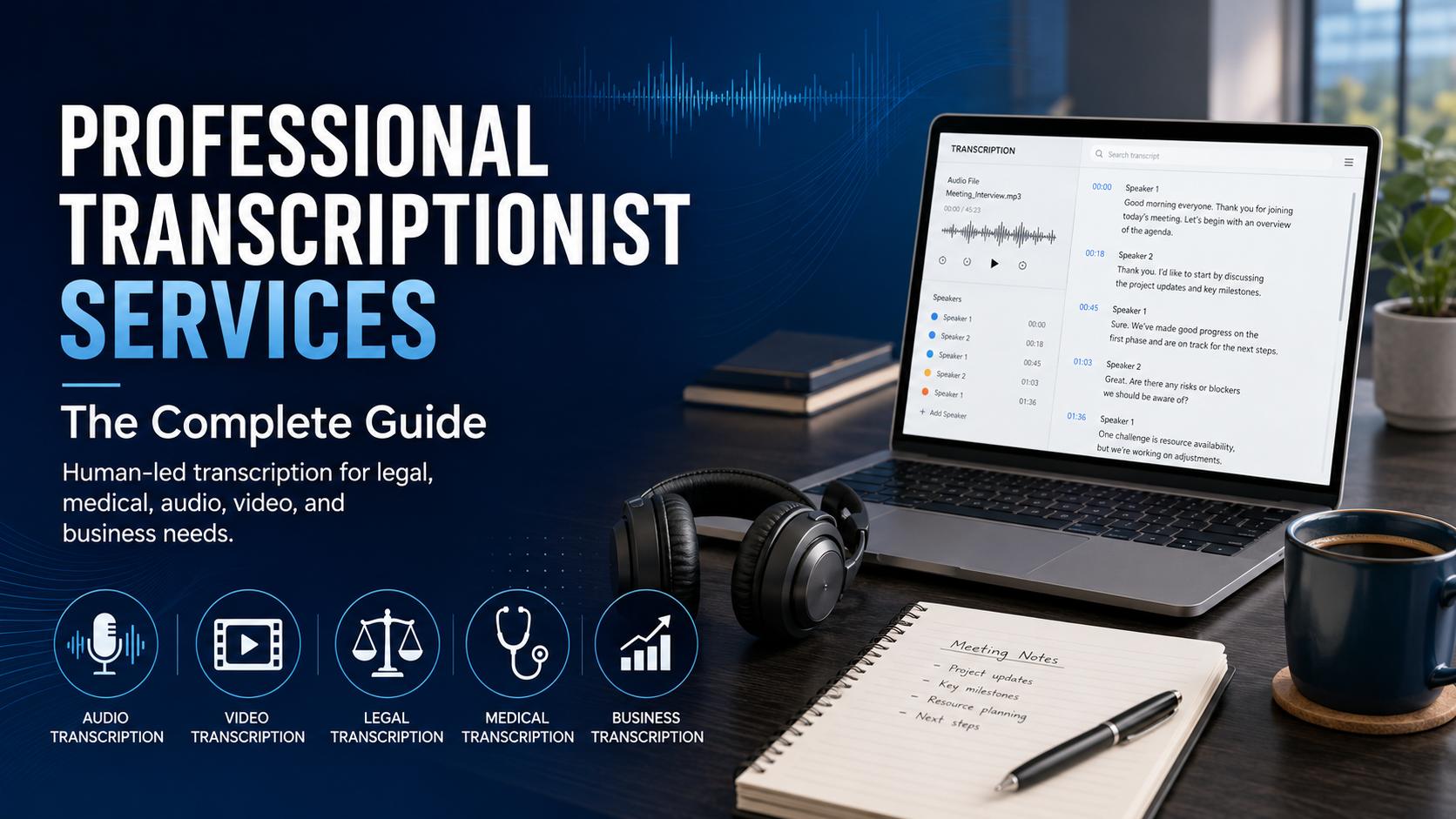
This guide explains what transcriptionist services include, why professional transcription matters, and how to choose the right provider for your audio transcription, video transcription, legal transcription, medical transcription, or business transcription needs.
What Are Transcriptionist Services?
Transcriptionist services convert spoken content into written text. This may include audio recordings, video files, interviews, meetings, hearings, medical dictation, research sessions, lectures, podcasts, webinars, conference calls, and more.
Professional transcription is different from basic speech-to-text conversion. A trained transcriptionist listens carefully, understands context, identifies speakers, follows formatting instructions, checks terminology, and produces a document that is easier to read and use.
Depending on the project, transcriptionist services may include:
- Audio transcription
- Video transcription
- Legal transcription
- Medical transcription
- Business transcription
- Interview transcription
- Academic and research transcription
- Edited transcription
- Full verbatim transcription
- Intelligent verbatim transcription
- Speaker identification
- Time-stamping
- Custom formatting
American Transcription Services offers intelligent verbatim, full verbatim, and edited transcription, along with optional speaker identification and time-stamping for legal, medical, academic, and corporate use.
Why Human Transcription Still Matters
Automated transcription may be useful in some low-risk situations, but it often struggles when recordings are complex. Real conversations include interruptions, overlapping speakers, accents, background noise, unclear words, technical terminology, and industry-specific language.
Human transcriptionists bring judgment to the process. They can understand context, flag unclear sections, distinguish speakers, research terminology, and format the transcript according to the client’s needs.
This is especially important for professional transcription in industries where accuracy and confidentiality matter. A legal team may need a transcript that is clear and court-ready. A healthcare provider may need careful handling of medical terminology. A business may need clean documentation from a strategy meeting. A researcher may need interviews transcribed in a way that preserves meaning and speaker intent.
American Transcription Services states that it is deliberately human-led and does not use AI or automated transcription engines to generate reports, using technology only to support secure workflows and operational efficiency.
1. Choose Human-Led Transcription Services
The first thing to look for in a transcription company is whether the work is completed by trained people or generated primarily by software.
Human-led transcription services are valuable because they focus on meaning, not just words. A professional transcriptionist can recognize when a word sounds similar to another word but does not fit the context. They can understand industry language, separate speakers, and apply client-specific formatting instructions.
This matters in high-stakes fields such as legal transcription, medical transcription, and business transcription. In these settings, a transcript may be reviewed by attorneys, physicians, executives, researchers, compliance teams, or clients. A rough transcript is not enough when the document needs to be reliable.
At American Transcription Services, files are handled by trained human transcription specialists with subject-matter expertise, and transcripts go through review and quality-control processes before delivery.
2. Look for Experience Across Different Industries
Not every recording is the same. A medical dictation is very different from a legal deposition. A corporate meeting is different from a research interview. A podcast transcript is different from a court-ready transcript.
That is why industry experience matters.
A professional transcription provider should understand the needs of different clients, including:
Legal Professionals
Legal transcription may include court proceedings, depositions, hearings, witness statements, attorney notes, arbitration recordings, or law enforcement interviews. These transcripts often require careful formatting, speaker identification, and attention to legal terminology.
Healthcare Providers
Medical transcription may include physician dictation, clinical notes, reports, patient-related documentation, and specialty terminology. Accuracy, confidentiality, and context are essential.
Businesses and Corporate Teams
Business transcription can include meetings, conference calls, board discussions, presentations, webinars, training sessions, and internal communications. A clean transcript helps teams document decisions, preserve knowledge, and create searchable records.
Researchers and Academic Teams
Interview transcription and research transcription help turn recorded conversations into organized text for analysis, reporting, publication, or archiving.
American Transcription Services supports legal professionals, healthcare providers, academic researchers, and corporate clients that need precision, discretion, and accountability.
3. Make Security and Confidentiality a Priority
Transcription often involves sensitive information. Legal recordings may include case details. Medical files may contain private health information. Business meetings may include confidential strategy, financial details, or client information. Research interviews may involve personal stories or protected participant data.
For that reason, security should never be treated as an afterthought.
Before choosing transcriptionist services, ask how the provider handles:
- File uploads
- Data access
- Confidentiality agreements
- Secure delivery
- Internal quality control
- Long-term file handling
- Compliance requirements
- Client-specific privacy instructions
American Transcription Services states that confidentiality is built into its workflow through secure access controls, confidentiality agreements, and secure file submission options such as an online portal, encrypted email, and approved cloud links.
4. Ask About Accuracy and Quality Control
Accuracy is one of the most important reasons to choose professional transcription services. A transcript should not simply look complete. It should be carefully reviewed, clearly formatted, and dependable enough for its intended use.
Quality transcription depends on several factors:
- Audio clarity
- Number of speakers
- Background noise
- Accents and speaking pace
- Technical vocabulary
- Formatting requirements
- Turnaround time
- Review process
A good transcription company should be honest about what affects quality. Clear audio will always help, but experienced transcriptionists can still work through challenging recordings more effectively than automated tools.
American Transcription Services highlights 99%+ accuracy, human-led transcription, and multiple quality checks as part of its accuracy commitment.
5. Make Sure Turnaround Times Fit Your Deadline
Deadlines matter. Attorneys may need transcripts before a hearing. Doctors may need documentation quickly. Businesses may need meeting notes before the next planning session. Researchers may need interviews completed before analysis can begin.
However, speed should not come at the cost of accuracy. Professional transcription takes careful listening, formatting, review, and quality control. A reliable provider should offer realistic turnaround options based on file length, audio quality, subject matter, number of speakers, and complexity.
American Transcription Services offers standard and expedited delivery options, with turnaround times structured around client urgency and business impact.
6. Choose the Right Transcript Format
One of the biggest benefits of professional transcription is the ability to request the format that fits your purpose.
Common transcript styles include:
Full Verbatim Transcription
Full verbatim captures speech as closely as possible, including false starts, filler words, repeated words, interruptions, and nonverbal sounds when relevant. This format may be useful for legal, research, or investigative work where every spoken detail matters.
Intelligent Verbatim Transcription
Intelligent verbatim removes unnecessary filler while preserving the speaker’s meaning. This format is often easier to read and is useful for interviews, meetings, business records, and professional documentation.
Edited Transcription
Edited transcription creates a polished version of the content. It may improve grammar, readability, and flow while keeping the main message intact. This format is helpful for presentations, articles, podcasts, reports, and public-facing content.
Time-Stamped Transcription
Timestamps help readers locate specific moments in an audio or video file. They are useful for video transcription, legal review, research analysis, captions, media production, and quality checks.
Speaker Identification
Speaker labels help organize conversations with multiple participants. This is essential for interviews, focus groups, court proceedings, meetings, and panel discussions.
American Transcription Services provides intelligent verbatim, full verbatim, and edited transcription, with optional speaker identification and time-stamping.
7. Consider Audio Transcription and Video Transcription Needs
Audio transcription and video transcription may seem similar, but each project can have different requirements.
Audio transcription is commonly used for:
- Dictation
- Phone calls
- Interviews
- Meetings
- Podcasts
- Lectures
- Voice notes
- Focus groups
Video transcription is commonly used for:
- Webinars
- Training videos
- Conferences
- Online courses
- Marketing videos
- Depositions
- Recorded presentations
- Video interviews
Video files may require additional attention to visual context, timestamps, captions, subtitles, or speaker changes. If the transcript will support video editing, accessibility, or content repurposing, formatting becomes even more important.
The right transcription provider should be able to guide you toward the best format based on how the final transcript will be used.
8. Use Transcription Blogs and Resources Before Choosing a Provider
Before hiring a transcription company, it helps to read transcription blogs and the best transcription resources available online. These resources can help you understand pricing, turnaround times, accuracy expectations, file preparation, formatting options, and the difference between automated and professional transcription.
However, do not rely only on generic advice. Every project has its own requirements. A business meeting, medical report, legal hearing, and research interview all need different handling.
When reviewing transcription blogs or comparing transcriptionist services, look for answers to practical questions:
- Does the company use human transcriptionists?
- Can they handle legal, medical, and business transcription?
- Do they offer speaker identification and timestamps?
- How do they protect confidential files?
- Can they customize formatting?
- Do they offer standard and expedited turnaround options?
- Is pricing clear before the work begins?
- Is there a review or quality-control process?
The best transcription resources should help you make a confident decision, not just choose the cheapest option.
9. Understand Pricing Before You Begin
Transcription pricing can vary depending on the length of the recording, audio quality, number of speakers, turnaround time, industry, formatting needs, and any special requirements.
A transparent provider should explain how pricing works before the project begins. This helps avoid confusion and makes it easier to compare service quality, not just cost.
American Transcription Services lists pricing from USD $0.95 per audio minute and explains that pricing may be adjusted based on quality, number of speakers, complexity, turnaround time, formatting, and add-ons.
10. Look for Helpful Customer Support
Professional transcription is a service, not just a file conversion process. You may need help choosing a transcript format, uploading files securely, clarifying deadlines, requesting a sample, explaining speaker labels, or setting up recurring work.
Strong customer support is especially important for law firms, hospitals, clinics, universities, research teams, and companies that submit multiple files or manage sensitive documentation.
A good transcription partner should be easy to reach, clear in communication, and willing to understand your workflow. American Transcription Services highlights 24x7x365 single point of contact support as one of its differentiators.
11. Know What to Prepare Before Sending Files
You can help your transcriptionist produce the best possible transcript by providing clear instructions at the beginning.
Before submitting your file, prepare:
- The audio or video file
- Desired turnaround time
- Transcript format preference
- Speaker names, if available
- Industry-specific terminology
- Required template or formatting rules
- Timestamp instructions
- Confidentiality requirements
- Notes about unclear audio or multiple speakers
Even small details can improve the final result. For example, providing a list of names, acronyms, or technical terms can help the transcriptionist produce a cleaner and more accurate transcript.
Final Thoughts
Choosing the right transcriptionist services is about more than finding someone to type what they hear. It is about trusting a professional team with your audio, video, words, records, and deadlines.
Whether you need legal transcription, medical transcription, business transcription, interview transcription, audio transcription, or video transcription, the right provider should offer human expertise, secure handling, accurate formatting, reliable turnaround times, and responsive support.
At American Transcription Services, we deliver professional transcription services prepared by trained human specialists for clients who need accuracy, confidentiality, and dependable results. From court-ready legal transcripts to medical documentation, interviews, business meetings, and professional audio or video transcription, our team is ready to help you turn important recordings into clear written records.
Need accurate, human-prepared transcription services? Contact American Transcription Services today to request a quote or get started with your next project.